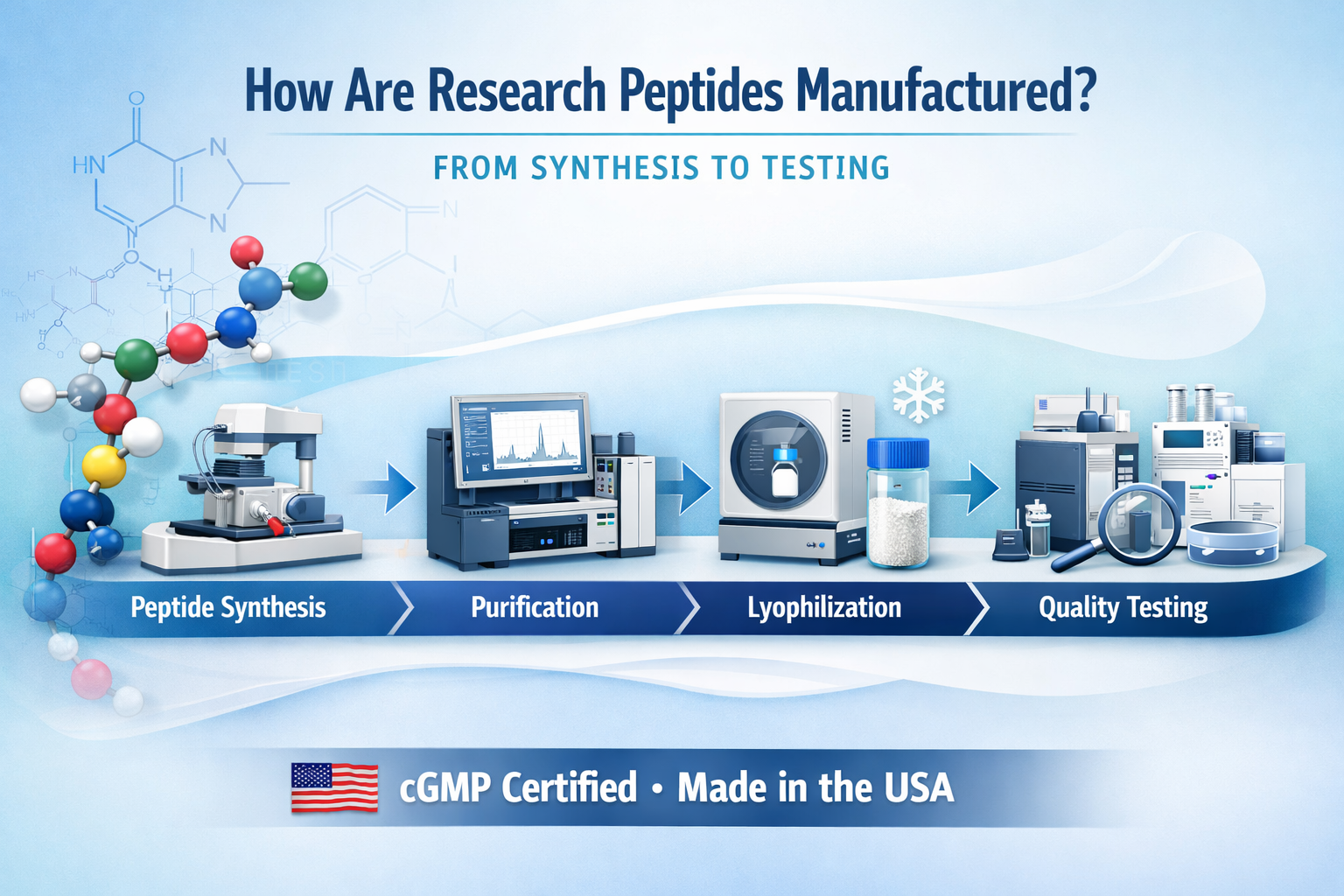
Peptide Screening Hplc & Uplc
A/c Peptide Screening Labs Third-party Peptide Evaluation
Some laboratories run their own interior tests, while others favor outdoors labs to verify searchings for. Whether inner or outside, all testing has to be carried out in regulated laboratory environments under Find more info established procedures. Peptide sequencing through Edman destruction or tandem mass spectrometry (MS/MS) offers definitive sequence verification by establishing the order of amino acids. While not all COAs consist of full sequencing information due to cost factors to consider, this information provides the highest degree of identity confirmation readily available.What Is Peptide Web Content?
Contrast of internal lab analysis and independent third-party screening utilized to validate logical results for research peptides. Together with chromatographic approaches, mass spectrometry adds to the more comprehensive framework used in evaluating lab-tested peptides. One more logical technique generally referenced in peptide paperwork is mass spectrometry. In peptide evaluation, the main top on the chromatogram typically corresponds to the expected substance. Additional tops may stand for other observable components existing in the sample. One of one of the most frequently used strategies in peptide pureness screening is high-performance fluid chromatography, generally abbreviated as HPLC.Being careful with these details stays clear of complication in the center of the study process. For laboratories that routinely handle several sets, understanding just how to review a CoA swiftly and accurately is important. These areas make use of some technical terms, but many adhere to the very same general style. The details discovered in a peptide CoA often begin with just how the product is tested.
Mass Spectrometry Confirmation
A Certificate of Evaluation is a technical document created from logical testing of a particular set of a compound. It accredits that the batch has been checked by a certified laboratory, and offers the real gauged data from that testing. A COA is not an assurance-- it is a record of what testing showed for that specific batch.
- It is used to reveal basic analytical information such as the item name, set or whole lot number, test day, and reported purity outcomes.
- The COA reports amino acid structure as molar ratios relative to a referral amino acid, generally readied to 1.00.
- Pureness shows the proportion of the vial that consists of the target peptide.
- Researchers typically check that the batch number on the CoA matches the tag on the product.
- This information enables researchers to assess prospective biological disturbance and speculative danger.
Item lot numbers can be found in the top right edge of item labels. PeptidePro Canada supplies research-use-only materials to customers in Canada. This is a much stronger analysis method than looking only at one percent number and neglecting the remainder of the record.
Each set is produced under stringent quality controls with documented procedures at every action. Products offered by Peptides Resource are not approved by the U.S . These items have not been evaluated by the FDA for safety and security, efficiency, diagnosis, therapy, avoidance, or https://edwinrjbb937.clearhavendigest.com/posts/just-how-to-check-out-a-coa-peptide-testing-overview remedy of any illness or clinical condition.Purity measurements for research study peptides are frequently established making use of analytical techniques such as high-performance fluid chromatography. These techniques different chemical components in an example so research laboratories can analyze obvious molecular signals. Mass spectrometry assists validate the molecular identification of peptide research study compounds by comparing measured mass signals with expected molecular weight. The reported purity suggests the percentage of the discovered substance about other noticeable parts in the example.